China Anodizing Equipment for Superior Surface Treatment and Finishing
2026-10-16
When it comes to achieving flawless surface finishes on aluminum components, the quality of your anodizing equipment is non-negotiable. China has emerged as a global leader in advanced manufacturing, and Junda is at the heart of this innovation. From precision surface treatment to immaculate finishing, discover how Junda's anodizing solutions can redefine your production standards and give your products the competitive edge they deserve.
Inside the Anodizing Tank: What Really Determines Finish Quality
The finish quality coming out of an anodizing tank is rarely decided by a single setting. It is the result of several variables interacting in real time: bath temperature, acid concentration, current density, and the way parts are racked. A few degrees of temperature drift or uneven agitation can shift pore structure enough to produce a dull, blotchy surface even when the same alloy and cycle time are used. Operators who get consistent results tend to watch the tank as a living system rather than a fixed recipe.
Alloy composition matters more than many realize. High-copper or high-silicon grades respond differently to the anodic layer, leaving darker or more uneven tones unless the voltage ramp and bath additives are adjusted. The distance between the part and the cathode, the condition of electrical contacts, and the age of the electrolyte also influence thickness distribution and color uniformity. A well-controlled tank depends as much on daily housekeeping and contact maintenance as on the main rectifier settings.
China’s Quiet Advantage in Surface Treatment Equipment
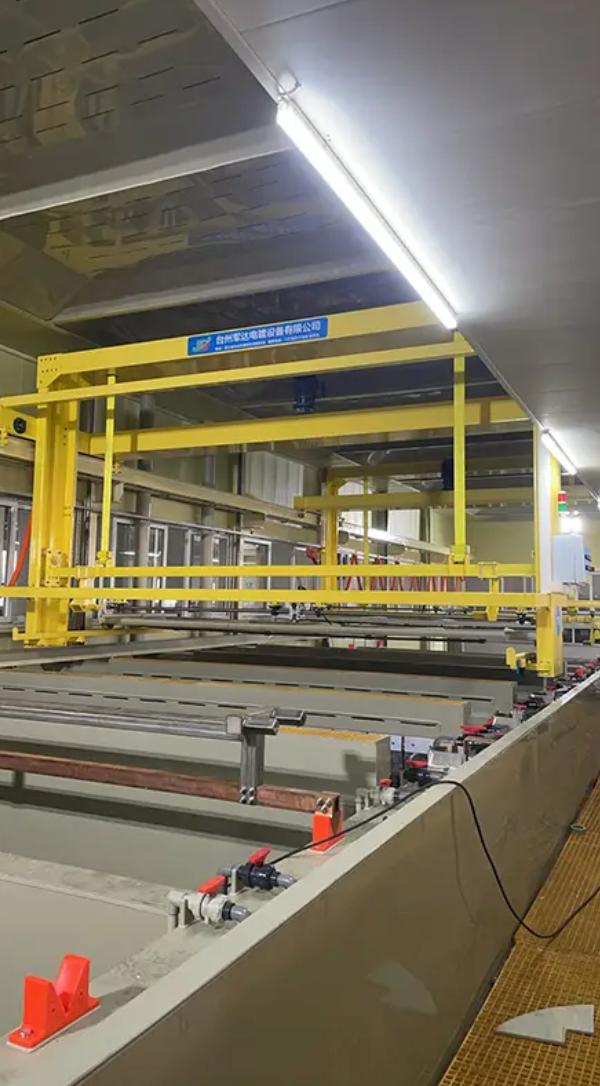
China’s surface treatment equipment sector has moved well beyond the old reputation for low-cost copying. Many builders now pair modular tank and line designs with unusually fast customization, letting mid-size manufacturers upgrade plating or phosphating lines without a full capital overhaul. The real edge often sits in the supply chain itself—rectifiers, pumps, filtration units, and control hardware are sourced within a tight geographic radius, which trims lead times and makes spare parts far less painful to obtain.
A second factor is the focus on practical engineering rather than spec-sheet theatrics. Instead of chasing exotic automation features, Chinese equipment makers tend to optimize what actually drives yield: chemical compatibility, rinse efficiency, and repeatable cycle timing. Automated hoist lines and closed-loop rinsing systems often ship with straightforward diagnostic screens that plant technicians can read without a vendor engineer on speed dial. In surface treatment, where consistency beats headline performance, that usability quietly separates capable suppliers from the rest.
The service model also breaks from the old import-driven norm. Smaller Chinese equipment firms frequently station engineers near industrial clusters, offering process tuning, retrofit kits, and local spare parts without multi-week import cycles. Buyers in Southeast Asia, the Middle East, and parts of Eastern Europe increasingly treat these systems as a practical alternative to legacy European or Japanese lines—not purely on upfront cost, but on how quickly the equipment adapts to a changing production mix.
How Modern Anodizing Lines Handle Difficult Alloys and Shapes
Modern anodizing lines tackle difficult alloys by moving beyond fixed current recipes. High-copper 2000 series and high-silicon casting alloys tend to burn or form smut if treated like standard 6061, so lines now use ramped current profiles, pulse waveforms, and tighter temperature control to keep the oxide layer growing evenly without overheating the surface. Bath chemistry has also become more flexible, with additives that reduce copper or silicon interference and allow a cleaner, harder finish on alloys that used to be considered marginal.
Complex shapes get their own set of fixes. Racks are designed with auxiliary cathodes or conforming counter-electrodes to pull current into deep recesses and around sharp corners, preventing thin spots or burns. Agitation has shifted from simple air bubbling to high-flow eductor systems that force fresh electrolyte through blind holes and narrow channels. Together with better load sequencing and real-time voltage monitoring, these changes let a single line process mixed racks without constantly re-tuning parameters.
The Link Between Equipment Design and Coating Consistency
The geometry of a coating head and the way it delivers fluid to a moving substrate often dictate whether the final layer ends up uniform or full of subtle streaks. Small changes in slot gap, lip angle, or internal manifold shape can create pressure variations that show up as thickness drift across the web. Operators who learn to read those patterns can usually trace them back to a specific design choice rather than blaming raw material alone.
Roll runout, bearing play, and even the stiffness of the frame interact with the coating station in ways that are easy to overlook until consistency suffers. A precision pump may deliver steady flow, but if the backup roll deflects under load or the metering gap shifts with speed, the wet film will vary no matter how stable the formulation is. Matching equipment rigidity and alignment to the expected line speed and viscosity range tends to do more for repeatability than chasing tighter sensor tolerances.
Lowering Operating Costs Without Losing the Mirror Finish
Mirror finishes have a reputation for eating through consumables, but most of that waste comes from habit rather than necessity. Switching to structured abrasive sequences instead of relying on one overworked buffing compound often cuts material spend by a noticeable margin while keeping the gloss deep and consistent. Small tweaks to wheel speed and pressure reduce heat buildup, which means fewer rework passes and less compound burned off before it does any real work.
The biggest hidden cost is usually time spent chasing defects that shouldn't exist in the first place. Keeping coolant filtration tight and monitoring pH in water-based systems prevents microscopic particles from scratching the surface between stages. On some alloys that alone eliminates a full finishing step. Operators who track roughness after each stage, rather than eyeballing the shine, catch dulling earlier and avoid re-polishing whole batches.
Maintenance gets overlooked because it doesn't feel like a direct cost. Dressing belts and replacing worn contact wheels on a schedule, not when the finish starts to fail, extends the life of every abrasive downstream. It also keeps the mirror predictable, so you're not burning labor on trial passes. A line that holds its gloss with lower input costs tends to stay that way longer without quietly trading away the surface quality.
Why Pretreatment and Sealing Matter as Much as the Anodizing Step
Most of the attention in anodizing tends to land on the visible oxide layer that forms during the electrolytic bath step. Yet the less glamorous stages before and after that immersion quietly determine whether the finish stays attractive, resists corrosion, and bonds well with adhesives or paints. Rushing through pretreatment leaves behind oils, extrusion die lines, or alkaline etch residue that get locked beneath the new oxide, causing blotchy dye uptake and premature localized failure. Skipping a proper seal, on the other hand, leaves the freshly formed pores wide open, turning a supposedly protective surface into a sponge for moisture, salts, and grime.
A well-designed pretreatment sequence is not a generic cleaning ritual but a tailored preparation that matches the alloy and the desired final look. For architectural aluminum, this often means a controlled alkaline etch to level minor surface defects, followed by a deoxidizing or desmut step to strip away the intermetallic smut left behind. In more demanding applications like automotive trim or marine hardware, even slight variations in etch temperature or rinse purity show up later as uneven reflectivity or dull patches. Treating this stage as a mere warm-up act usually results in rework costs that far exceed the time saved at the tank.
Sealing deserves the same rigor. Whether using hot deionized water, a nickel-based seal, or a cold chemical option, the goal is not simply to close the top of each pore but to hydrate and swell the anodic structure so that it becomes genuinely non-absorptive under real-world exposure. Under-sealed parts fail salt spray or filiform corrosion tests even when their coating thickness looks impressive on a micrometer. Meanwhile, over-sealing in certain dye systems can shift the hue or create a chalky haze. Getting this balance right transforms anodizing from a basic coloring method into a long-term surface treatment that holds its own against powder coating and wet paint.
FAQ
Start with the rectifier's ripple specification and the tank construction materials. A low ripple output and properly welded PP or PVC tanks make a far bigger difference to coating consistency than most spec sheets suggest.
For sulfuric acid anodizing, PP or PVC linings with proper welding are common, but the critical point is joint quality and chemical resistance at elevated temperatures. A poorly welded lining can leak and cause downtime far sooner than expected.
It depends on the rectifier capacity, cooling ability, and agitation design. Hardcoat requires higher voltage and much better heat removal, so some lines are built with extra chilling capacity and air or eductor agitation to switch between processes.
Automated hoists with recipe-based control reduce variation in dwell times and transfer speeds. PLC systems also log bath temperature and current density, which helps operators trace any batch quality issues quickly.
Architectural aluminum, automotive trim, consumer electronics housings, and aerospace components are common. The demand for consistent appearance and corrosion resistance pushes buyers toward lines with better process control rather than the lowest-priced setups.
Many suppliers offer remote commissioning, detailed operation manuals, and video training for the buyer's maintenance team. Some also send engineers for on-site startup and troubleshooting during the first production runs.
The rectifier's ripple and voltage stability directly influence pore structure and hardness of the anodic layer. A unit with the right voltage range and low ripple will produce a more uniform finish than an oversized but unstable power supply.
Conclusion
The finish quality inside an anodizing tank is rarely the result of a single variable. Electrolyte agitation, temperature gradients, and racking geometry all interact in ways that either sharpen or dull the final oxide layer. Chinese equipment builders have turned this complexity into a quiet advantage—designing rectifiers, chillers, and cathode arrangements that hold process parameters within tighter bands than many legacy systems. Pretreatment and sealing steps, often treated as afterthoughts, receive equal engineering attention in these lines, because a flawless anodic layer means nothing if residual soils or poor pore closure compromise corrosion resistance.
Modern anodizing lines from Chinese manufacturers also handle difficult alloys and complex shapes without sacrificing throughput. High-silicon castings, 7000-series extrusions, and parts with deep recesses demand adaptive current ramping and specialized agitation—features now standard in well-designed equipment. That same focus on equipment design directly drives coating consistency: uniform current distribution across racks, precise temperature control, and automated transfer timing reduce batch-to-batch variation. Operators can lower operating costs by recovering drag-out, optimizing chemical dosing, and using energy-efficient rectification, all while preserving the mirror finish that customers expect. The result is a complete surface treatment system where every stage—from cleaning to sealing—works as one controlled process rather than a series of isolated steps.
Contact Us
Contact Person: hayyr
Email: [email protected]
Tel/WhatsApp: 8613082110525
Website: https://www.jundaelectroplating.com